AI UX Engineering·20 min read·April 20, 2026
Graceful Degradation: Designing AI Features That Fail Without Breaking Trust
Every AI feature will fail. Models hallucinate, services crash, confidence drops below usable thresholds. The question is never whether your AI will fail — it is whether users will still trust your product afterward. That depends entirely on how you design the failure.

Viktor BezdekEngineering / Product Leadership
On a Tuesday morning in January, a major AI coding assistant went down for forty minutes. Engineers around the world opened their editors and found... nothing. No suggestions. No autocomplete. No inline explanations. The tool had become so integrated into their workflows that its absence was not an inconvenience — it was a wall. Projects stalled. Pull requests sat unreviewed. Junior developers who had never coded without AI assistance literally did not know where to start. The tool's absence revealed how deeply it had embedded itself in the workflow. But the outage was not the failure. The failure was that the product had no degradation strategy. It was either fully on or fully off, with nothing in between.
Compare this to how a different AI product handled a similar situation. When the model service became unavailable, the product seamlessly switched to a smaller, locally cached model with reduced capability. Suggestions were less sophisticated but still functional. A subtle banner informed users: 'Running in offline mode — suggestions may be less accurate.' Developers barely noticed the transition. When the full service returned, the product switched back without interruption. Same outage. Radically different user experience. The difference was not better infrastructure. It was better failure design.
AI Failure Is Not an Edge Case
Traditional software has a binary relationship with failure: it works or it errors. An API returns 200 or 500. A function returns a value or throws an exception. The failure states are discrete and identifiable. AI products exist in a continuous space of partial failure. The model is always running but sometimes its output is excellent, sometimes adequate, sometimes wrong, and sometimes dangerously wrong — and the system may not know which state it is in.
This continuous failure space means degradation is not an emergency response. It is a constant operating condition. At any given moment, some AI feature in your product is performing suboptimally for some users. The confidence score on that recommendation is too low for the context. The latency on that generation exceeds the user's patience. The hallucination rate on that synthesis crosses the accuracy threshold. If you design for these conditions reactively — if degradation is something that happens when things go wrong — you have already failed. Degradation strategy must be a first-class element of your AI product architecture, as intentional and well-designed as the happy path.
If your AI feature is either fully on or fully off, you have not designed for AI failure. You have designed for traditional software failure and hoped the AI would cooperate.
A Taxonomy of AI Failure Modes
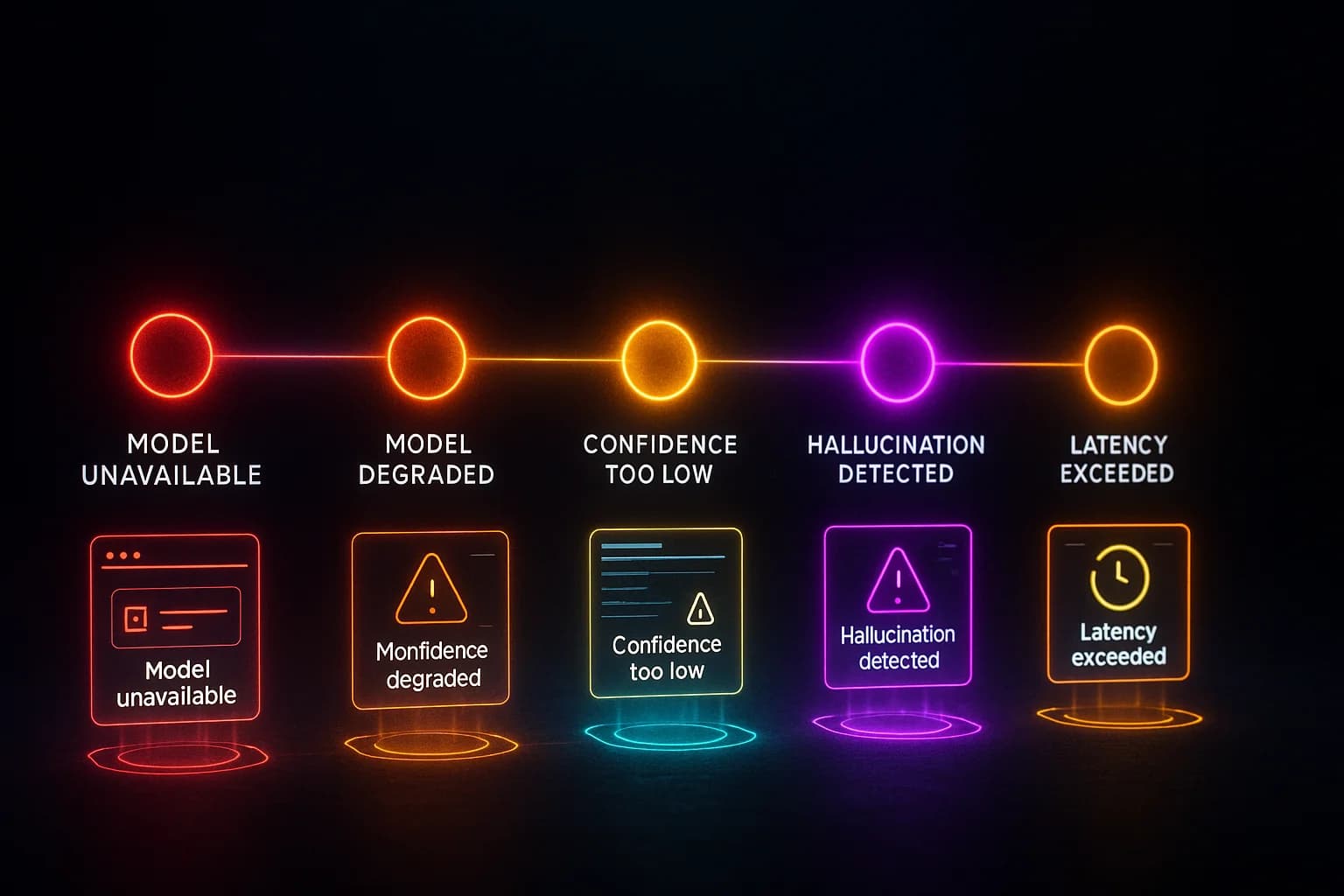
Effective degradation starts with a clear understanding of how AI features fail. There are five distinct failure modes, each requiring a different design response.
Mode 1: Complete Unavailability
The model service is down. No inference is possible. This is the simplest failure mode and the one most teams design for — because it looks like traditional software failure. The degradation response is to fall back to a non-AI alternative: cached results, rule-based heuristics, or manual workflows. The key design principle is that the non-AI fallback should be discoverable and functional without AI ever having been present. If your UI is structured so that the AI feature's absence leaves a visible hole, your architecture is too tightly coupled.
Mode 2: Degraded Quality
The model is running but producing lower-quality outputs than usual — perhaps because a less capable model was substituted, the context window is constrained, or the model is under heavy load. The user is getting results, but they are not as good as they expect. This is the most insidious failure mode because neither the system nor the user may recognize it immediately. The degradation response is to monitor output quality metrics in real time and adjust the UI when quality drops: show confidence indicators, add review prompts, or switch to a simpler mode that sets appropriate expectations.
Mode 3: Low Confidence
The model produces output but its confidence score is below the threshold for the current context. For a medical AI, this might mean confidence below 80 percent. For a spelling suggestion, it might mean confidence below 60 percent. The output exists but the system does not trust it enough to present it as a recommendation. The degradation response varies by context: suppress the output entirely (for high-stakes contexts), present it with heavy hedging and verification prompts (for medium-stakes), or present it normally (for low-stakes contexts where the user can easily detect and correct errors).
Mode 4: Detected Hallucination
The system's safety layer detects that the model's output contains factual errors, inconsistencies, or fabricated information. This is different from low confidence — the model may be highly confident in wrong output. The degradation response is to suppress the hallucinated content and either regenerate with a different approach, present the non-hallucinated portions with a gap indicator, or escalate to a human review pathway. Never silently present content that the system has flagged as potentially hallucinated.
Mode 5: Latency Exceeded
The model is running but taking longer than the user's patience threshold. This is a failure of time, not quality. The degradation response depends on whether partial results are available. If streaming is possible, show partial results as they arrive. If not, offer a choice: wait for the complete result, accept a faster but lower-quality result from a simpler model, or cancel and try a different approach.
The Fallback Chain Pattern
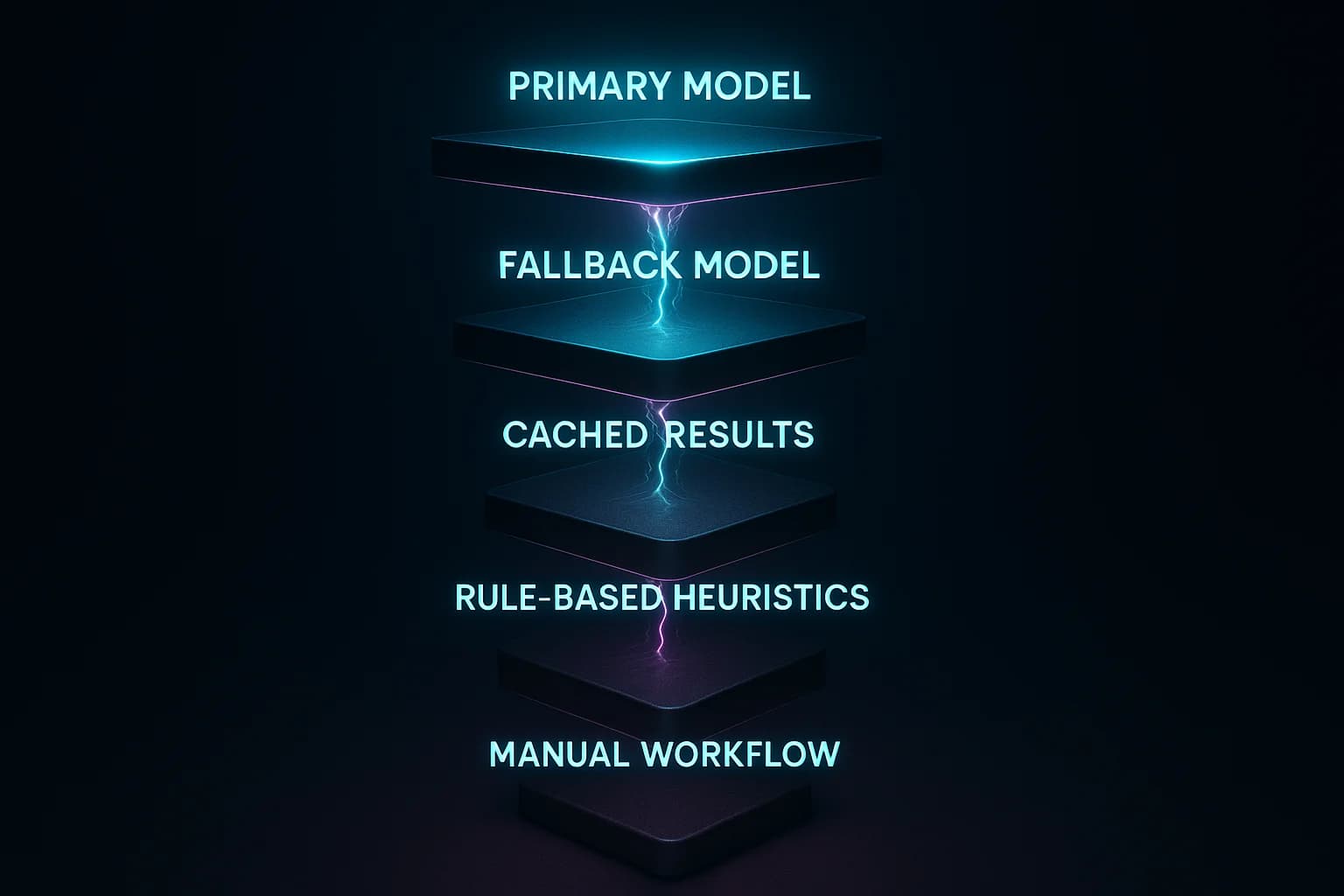
The core architectural pattern for AI degradation is the fallback chain — a prioritized sequence of increasingly simple alternatives that the system moves through as the primary AI capability degrades. A well-designed fallback chain for an AI writing assistant might look like this: primary model (GPT-4 class, full capability), secondary model (smaller model, reduced capability but faster and more reliable), cached suggestions (pre-computed suggestions for common patterns), rule-based heuristics (grammar and spelling checks without AI), manual mode (the editor works normally with no AI features). Each level in the chain trades capability for reliability.
The transitions between levels should be as invisible as possible for downward moves (the system should not announce every fallback) and celebratory for upward moves (when the primary model recovers, the user should notice the upgrade). A subtle transition indicator — 'AI suggestions restored' — is appropriate when moving back up the chain. But interrupting the user's flow to announce 'We switched to a simpler model' is usually more disruptive than the degraded experience itself.
Communicating Failure Without Destroying Trust
How you communicate AI failure matters as much as how you handle it technically. The wrong communication erodes trust. The right communication can actually strengthen it — because users who see a system handle failure gracefully develop more confidence in the system than users who never see it fail.
The principles for failure communication are straightforward. Be specific about what is affected — 'AI suggestions are temporarily unavailable' is better than 'Something went wrong.' Be honest about the limitation without being alarmist — 'Responses may be less detailed while we are running in reduced mode' sets expectations without creating anxiety. Provide a clear alternative — 'You can continue writing normally; AI suggestions will return automatically' tells the user what to do. And never blame the user — 'We could not process your request' is better than 'Your request was too complex.'
- Be specific: Name the affected feature, not just that 'something is wrong'
- Be honest without alarming: 'Running in reduced mode' not 'CRITICAL AI FAILURE'
- Provide alternatives: Tell users what they can do right now, not just what is broken
- Set expectations: If recovery is expected, say when — 'Usually resolves within minutes'
- Never blame the user: The system's limitations are the system's responsibility
- Acknowledge and move on: One brief notification, not repeated warnings that interrupt flow
Users who see a system handle failure gracefully develop more confidence than users who never see it fail. Trust is not built by perfection. It is built by honest, competent recovery.
Confidence-Gated UI: The Progressive Disclosure of AI
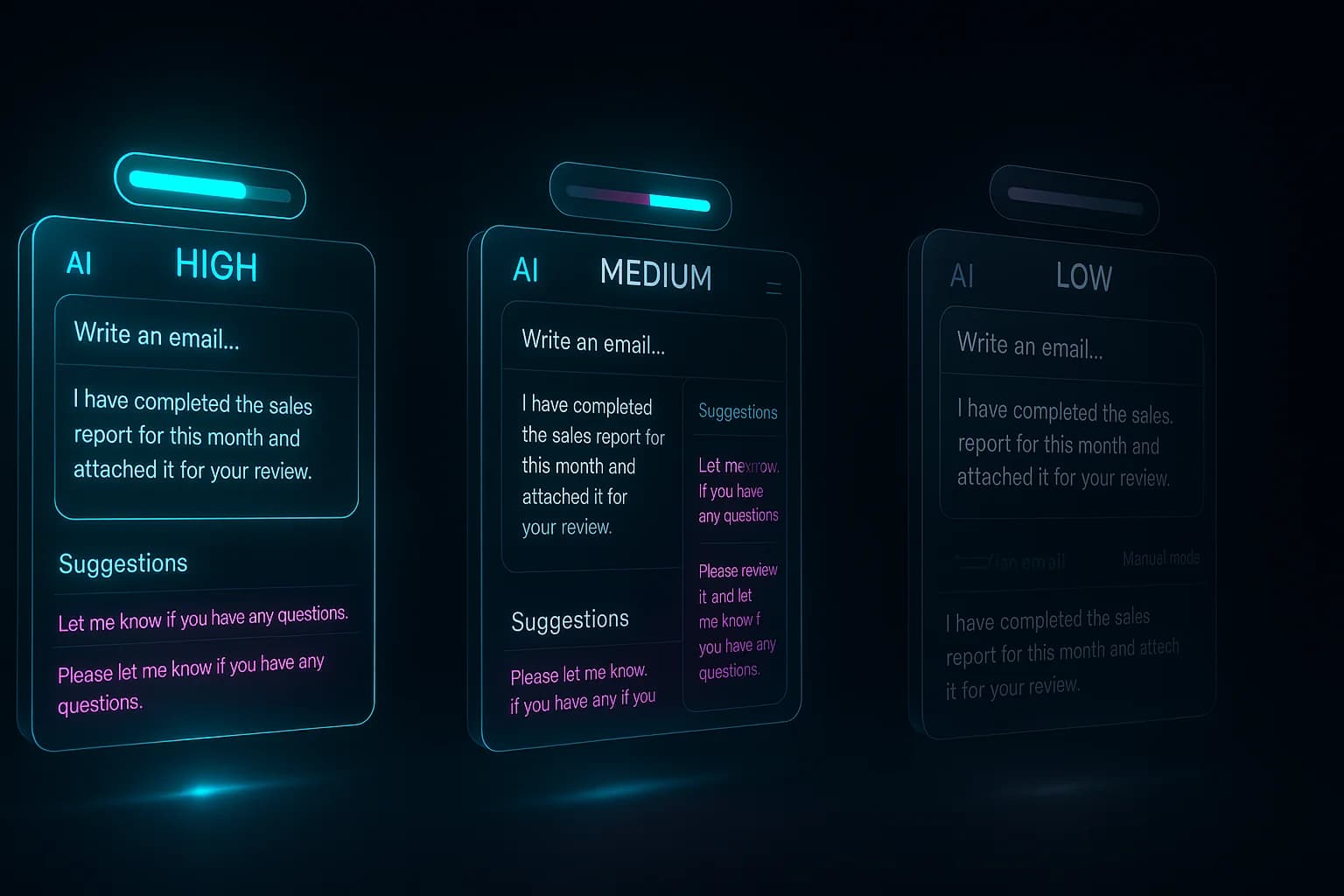
One of the most effective degradation patterns is confidence-gated UI — dynamically adjusting how much AI capability the interface exposes based on the model's current confidence level. At high confidence, AI features are prominent: suggestions appear inline, automations execute with minimal friction, and the AI is a visible collaborator. At medium confidence, AI features become more conservative: suggestions appear in a sidebar rather than inline, automations require confirmation, and hedging language appears. At low confidence, AI features recede: suggestions are available only on request, automations are disabled, and the interface operates in a primarily manual mode with AI assistance available as an explicit opt-in.
This pattern is powerful because it makes the AI's reliability visible through interaction design rather than through explicit labels or warnings. The user does not need to read a confidence score. They experience the AI's current capability directly through the interface's behavior. When suggestions appear inline and execute smoothly, the AI is confident. When suggestions require an extra click to see, something is different. The interaction itself is the confidence indicator.
Testing Your Degradation Strategy
Degradation design is only as good as its testing. Most teams test happy paths exhaustively and failure paths not at all. For AI products, invert this ratio. Your happy path is straightforward — the model works and produces good output. Your failure paths are where the product's character is revealed.
- Kill the model: Completely disable your AI service and verify that every feature degrades gracefully. No blank screens. No infinite spinners. No error messages that leave users stranded
- Throttle the model: Introduce artificial latency (5s, 10s, 30s) and verify that timeout handling and streaming fallbacks work correctly at each threshold
- Inject low confidence: Override the model's confidence scores to force low-confidence paths. Verify that hedging language, confirmation prompts, and suppression logic all activate correctly
- Feed adversarial inputs: Send prompts designed to trigger hallucination and verify that your safety layer catches them and the UI handles the flagged output appropriately
- Simulate partial recovery: Bring the model back from failure while users are mid-task. Verify that the transition from fallback to primary mode is smooth and does not lose user context
- Measure user perception: After each degradation test, ask users to rate their experience. A well-designed degradation should result in 'I noticed it was a bit slower' not 'I thought the product was broken'
The Trust Equation
Here is the counterintuitive insight that makes graceful degradation a competitive advantage rather than just a defensive measure: a product that fails gracefully earns more trust than a product that appears to never fail. Users are not naive. They know AI is imperfect. When a product pretends to be infallible and then fails spectacularly, the gap between promise and reality destroys trust. When a product communicates honestly about its limitations, handles failures smoothly, and always provides a path forward, users develop resilient trust — trust that can survive the inevitable failures because it was never built on the illusion of perfection.
This is not a consolation prize. It is a strategic insight. The teams that invest in degradation design build products that users stick with through imperfect experiences because the product has demonstrated, through its behavior during failures, that it is trustworthy. The teams that invest only in the happy path build products that users abandon at the first significant failure because the product never established the kind of trust that survives imperfection.
Key Takeaways
- AI failure is not an edge case — it is a constant operating condition. Degradation strategy must be a first-class design element, not an emergency response
- Five distinct failure modes (unavailability, degraded quality, low confidence, hallucination, latency) each require different design responses
- The fallback chain pattern provides a prioritized sequence of increasingly simple alternatives, trading capability for reliability at each level
- Confidence-gated UI dynamically adjusts how prominent AI features are based on current reliability — the interaction itself becomes the confidence indicator
- Communicate failure specifically, honestly, and with clear alternatives. Never blame the user. Downgrade silently, upgrade visibly
- Test failure paths more rigorously than happy paths. Kill the model, throttle it, inject low confidence, and feed adversarial inputs — then measure user perception of each degradation
- Products that fail gracefully earn more trust than products that appear infallible — because trust built on honesty survives imperfection, while trust built on illusion does not
The best AI product is not the one that never fails. It is the one that fails so well that users barely notice — and when they do notice, they are reassured rather than alarmed. This is the engineering challenge of graceful degradation: building systems where failure is not the absence of the product but a different, simpler, more honest version of it. A version that says, in effect, 'I cannot do my best work right now, but I can still help. And I will be back at full strength soon.' That is not a failure message. That is a trust signal. And in the age of AI, trust signals are the most valuable thing your product can produce.
AI DegradationFailure DesignTrustFallback PatternsAI ReliabilityEngineering Patterns
KEEP READING
Related Articles
AI UX Engineering·22 min read
The Architecture of Undo: Building Reversible AI Actions in Production Systems
Your AI agent just booked the wrong flight, sent a premature email, and modified a production database. Ctrl-Z does not work here. Reversible AI actions require event sourcing, compensating transactions, and an entirely new engineering discipline for undoing the real world.
UX Research Methods·25 min read
Beyond Nielsen’s 10: Usability Heuristics for the AI Era
Nielsen’s heuristics were built for buttons and menus. AI products need heuristics for trust calibration, graceful error recovery, and the strange new problem of systems that are confidently wrong. Here are eight principles to evaluate what the original ten cannot.