UX & AI·24 min read·February 7, 2026
From GUI to Intent: Why Your Carefully Designed Buttons Don’t Matter Anymore
Jakob Nielsen declared the death of the GUI. When users delegate tasks to AI agents instead of clicking through your flows, the new UX battleground shifts from pixel-perfect layouts to API discoverability, data structure clarity, and autonomous action safety.

Viktor BezdekEngineering / Product Leadership
Your design team just spent four months perfecting a checkout flow. They tested button colors, agonized over micro-copy, A/B tested the placement of trust badges, and shaved 200 milliseconds off the loading animation. The flow converts at 4.2%, which is excellent. Here is the problem: increasingly, nobody is going to click those buttons. The user will say ‘order my usual coffee supplies from that vendor we used last month’ to an AI agent, and the agent will hit your API directly, bypassing every pixel your team lovingly placed. The checkout flow still matters for the humans who visit your site manually, of course. But the marginal user — the one your competitors are fighting you for — is delegating to an agent. And agents don’t see buttons.
Jakob Nielsen, the father of usability heuristics, declared 2025 the beginning of the end for graphical user interfaces as the dominant interaction paradigm. His argument was not that GUIs would vanish overnight, but that their forty-year reign as the primary mediator between human intent and system capability was ending. The new mediator is an AI agent that understands what the user wants to accomplish and negotiates directly with systems to make it happen. The user never sees a form, never clicks a dropdown, never navigates a menu tree. They express an outcome and the agent figures out the steps. This is not a speculative future. It is happening now across scheduling, shopping, travel booking, code deployment, and customer support — every domain where the steps between intent and outcome are tedious enough to delegate.

The Backend Becomes the User Interface
For engineers, this shift creates a strange inversion. For decades, the frontend was the prestige layer — the part of the stack that users saw, that leadership cared about, that received the most design investment. The backend was infrastructure: important but invisible. Now the backend is becoming the user-facing surface. When an AI agent interacts with your system, it engages exclusively with your API layer, your data structures, your error responses, your state management. The quality of that interaction — how discoverable your endpoints are, how semantic your data models are, how gracefully your system handles edge cases — determines whether the agent can complete the user’s task. Your backend’s design quality IS your user experience.
Your backend’s design quality IS your user experience.
From Tasks to Outcomes: The Capability Map
This demands a fundamental shift from task-based design to outcome-oriented design. Traditional UX decomposes a user goal into a sequence of tasks: search for a product, select options, add to cart, enter shipping address, choose payment method, confirm order. Each task gets a screen. Each screen gets a layout. The whole thing is a carefully choreographed funnel. But an AI agent does not need a funnel. It needs to know: what outcomes are possible, what inputs each outcome requires, what constraints govern each outcome, and what happens when constraints are violated. The agent assembles its own ‘funnel’ dynamically based on the user’s specific context. Maybe the shipping address is already known. Maybe the payment method is on file. Maybe the user wants to split the order across two delivery dates. The agent doesn’t need to be walked through your predetermined flow — it needs a capability map.
Building capability maps is an engineering problem, not a design problem. It requires your system to expose its affordances programmatically. Today, most APIs document what endpoints exist and what parameters they accept. A capability map goes further: it describes what outcomes the system can produce, the preconditions for each outcome, the relationships and dependencies between actions, the constraints that narrow the solution space, and the side effects of each action. This is richer than an OpenAPI specification. It is closer to what the artificial intelligence community calls an ‘action schema’ — a formal description of what an agent can do within a system, enabling it to plan multi-step sequences toward a goal.

Consider the difference through a concrete example. A traditional e-commerce API might expose: POST /cart/items, PATCH /cart/items/:id, DELETE /cart/items/:id, POST /checkout, GET /orders/:id. An outcome-oriented API for the same system might additionally expose: a capabilities manifest listing available outcomes (place-order, reorder-previous, modify-pending-order, return-item), the input requirements for each outcome (place-order requires: items, shipping address, payment method — with indicators of which are already known from context), the constraints that apply (minimum order amount, items in stock, delivery area coverage, payment method validity), and the resolution paths when constraints are violated (item out of stock: suggest alternatives, address outside delivery zone: offer pickup locations). The first API is perfectly functional for a developer building a frontend. The second is navigable by an AI agent reasoning about how to fulfill a user’s intent.
This is where the competitive inversion happens — and it is the most important strategic insight in this entire shift. Your competitor might have a clunky, outdated UI. Their checkout flow might convert at 2.8% for human visitors. But if their backend exposes rich, semantic, outcome-oriented capabilities that AI agents can navigate fluently, and yours does not, agents will route users to your competitor. Not because the competitor’s product is better, and not because their brand is stronger, but because their system is easier for the agent to work with. In a world where agents mediate an increasing share of transactions, being agent-navigable is a moat. Being agent-hostile is a slow leak.
The Four Engineering Layers of Agent-Native Design
The engineering implications cut across four distinct layers, and each requires a different kind of thinking. The first layer is data structure clarity — making your data models self-explanatory to machine reasoning. This goes beyond good naming conventions. Agent-readable data structures need semantic types (not just ‘string’ but ‘email-address’ or ‘iso-currency-code’), explicit relationships between entities (an order contains line-items, each line-item references a product, each product belongs to categories), value constraints expressed as machine-readable rules (quantity must be positive integer, delivery date must be future, discount code must match pattern), and enumerated valid states with transition rules (order can move from draft to placed to shipped to delivered, but not from shipped back to draft).
- Semantic types beyond primitives (e.g., 'email-address' instead of 'string')
- Explicit entity relationships (order > line-items > products > categories)
- Value constraints as machine-readable rules (quantity must be positive integer)
- Enumerated valid states with transition rules (draft > placed > shipped > delivered)
The second layer is intent resolution — the ability for your system to accept underspecified requests and resolve them intelligently. In a GUI, you can force the user through a wizard that collects every required field before allowing submission. Agents don’t want wizards. They want to express partial intent and have the system either fulfill it with reasonable defaults or respond with precisely what additional information is needed. This is a genuinely different API design pattern. Instead of rejecting a request because a required field is missing, an intent-resolving system responds with: here is what I can infer from what you gave me, here is what I still need, here are the options for each missing piece, and here is what I will do by default if you provide nothing further. This turns your API from a gate into a collaborator.
Think about booking a meeting room. A GUI approach requires selecting date, time, duration, room, number of attendees, and required equipment — six discrete form fields. An intent-resolving system accepts ‘book a room for the design review next Tuesday’ and responds: I know the design review is on your calendar for Tuesday 2-3pm with 8 attendees. I found 3 available rooms that fit 8+ people with a display for screen sharing. Room 4B is closest to your usual meeting area. Shall I book 4B, or would you prefer one of the alternatives? The agent made five decisions on the user’s behalf (date, time, duration, equipment needs, room preference) and is asking for confirmation on the sixth. This is not ‘smart defaults’ in the traditional UX sense. It is the system actively reasoning about the user’s context and offering a nearly-complete resolution that the agent can accept or adjust.
The Accountability Surface
The third layer is what I call the accountability surface — the set of mechanisms that allow autonomous agent actions to remain auditable and reversible. This is the hardest engineering problem in the agent-native paradigm and the one most teams are ignoring. When a human clicks a button, there is an implicit accountability chain: the human saw the screen, understood the action, and clicked intentionally. When an agent acts on a user’s behalf, that chain breaks. Who authorized this specific action? Was the user’s original intent faithfully preserved through the agent’s interpretation? What if the agent’s reasoning was subtly wrong?
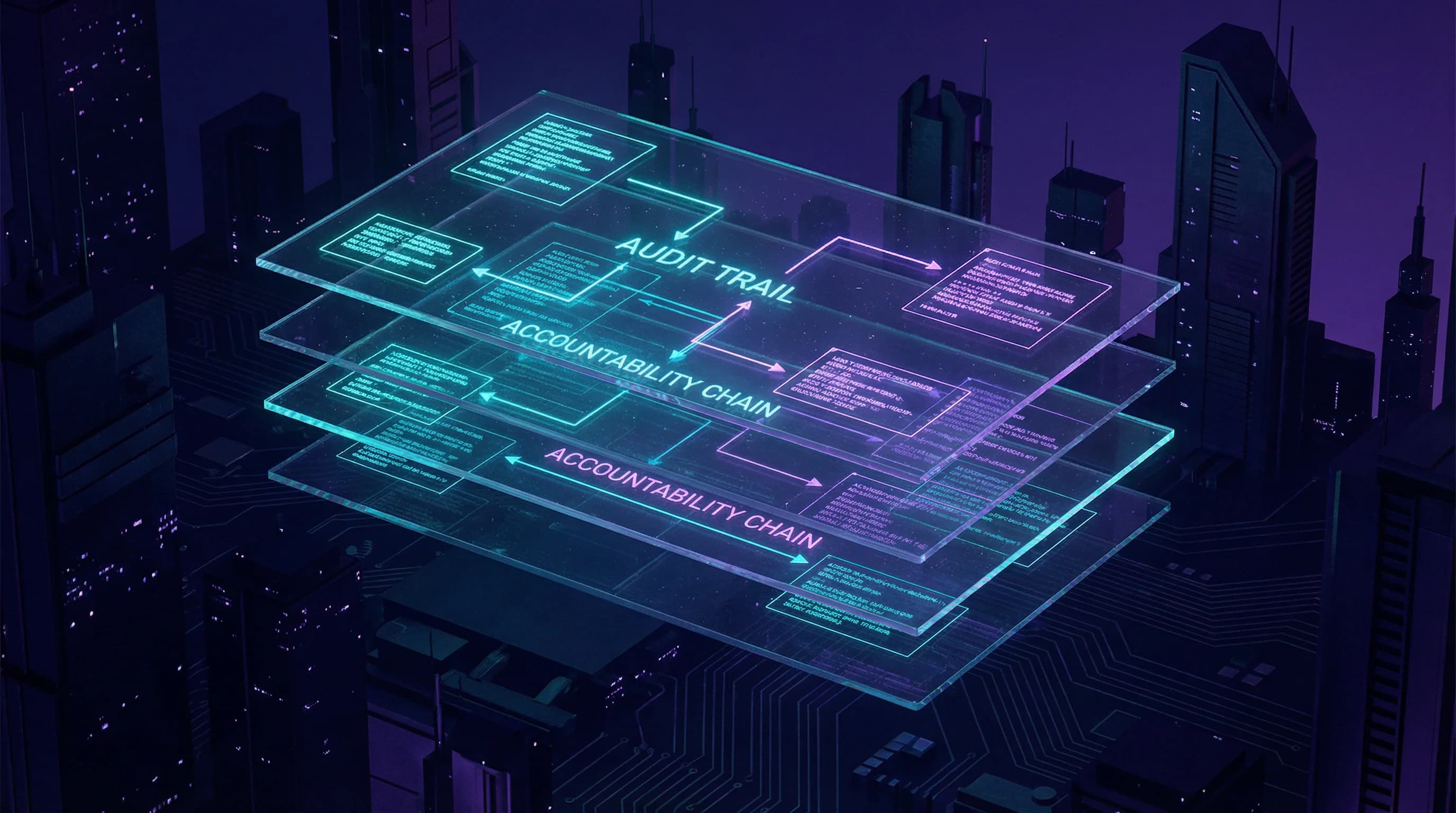
Accountability surfaces require: comprehensive action logging that captures not just what happened but the agent’s reasoning chain (why it chose Room 4B, what alternatives it considered, what context it used), tiered confirmation thresholds (low-risk actions execute automatically, medium-risk actions log with undo window, high-risk actions require explicit user confirmation), clear undo and rollback semantics for every autonomous action (the agent booked the wrong room — can it be cancelled without side effects?), and attribution metadata on every system change (this modification was made by Agent X acting on behalf of User Y at timestamp Z in response to intent W). Without these mechanisms, autonomous agents create liability nightmares. With them, they create a more auditable trail than human point-and-click ever did.
Discoverability and Agent Manifests
The fourth layer is what makes all the others commercially viable: discoverability. In the GUI world, discoverability means a user can find features by exploring menus and scanning interfaces. In the agent world, discoverability means an agent can understand what your system does without prior training or custom integration. This is the layer where most systems fail catastrophically today. Your API documentation might be thorough, but it was written for human developers reading docs and writing code. An AI agent needs machine-readable capability descriptions: not Markdown docs, but structured schemas that describe available actions, their purpose, their constraints, and their relationships to each other.
The emerging pattern here is what some are calling ‘agent manifests’ — standardized, machine-readable descriptions of a system’s capabilities, similar in concept to a web app’s manifest.json but richer. An agent manifest describes: the system’s domain and purpose in natural language (so agents can determine relevance), the available actions with semantic descriptions (not just endpoint paths but what each action accomplishes in the real world), the authentication and authorization model (how the agent proves it acts on a user’s behalf), the data model with semantic types and relationships, the constraint system with human-readable explanations, and the system’s current operational status. A well-crafted agent manifest lets an AI agent ‘understand’ your system in seconds the way a developer understands it after reading documentation for an hour.

- Domain and purpose described in natural language for relevance matching
- Available actions with semantic descriptions of real-world outcomes
- Authentication and authorization model for agent-on-behalf-of-user flows
- Data model with semantic types and entity relationships
- Constraint system with human-readable explanations
- Current operational status and health indicators
From Friction Reduction to Ambiguity Reduction
There is a deeper philosophical shift underneath all four layers that engineers need to internalize. In the GUI paradigm, the designer’s job was to reduce friction — make each step easier, faster, more intuitive. In the intent paradigm, the engineer’s job is to reduce ambiguity. Friction is a GUI problem because humans experience each step. Ambiguity is an agent problem because agents need to reason correctly about what to do next. Every ambiguous data type, every undocumented constraint, every implicit business rule that ‘everyone just knows’ is a trap for an agent that will reason its way into a wrong action. Making your system unambiguous is not the same as making it simple. Complex systems can be unambiguous if their complexity is explicitly modeled rather than hidden in tribal knowledge.

Agent-native design is not a tax on your engineering — it is a forcing function for the engineering rigor you always meant to have.
This shift from friction-reduction to ambiguity-reduction has a counterintuitive implication for engineering priorities. The highest-ROI work for agent-native readiness is often not building new features but documenting and formalizing the existing ones. That business rule buried in a comment on line 847 of your order service? Formalize it into a constraint. That implicit state machine your team ‘just knows’ governs how subscriptions work? Make it explicit and machine-readable. Those error codes that return the same 400 for six different validation failures? Differentiate them. The irony is that the work required to make systems agent-navigable is the same work that makes them more maintainable, testable, and understandable for human developers. Agent-native design is not a tax on your engineering — it is a forcing function for the engineering rigor you always meant to have.
The timeline for this shift matters, and it is shorter than most teams assume. We are not talking about a decade-long transition like the move from desktop to mobile. AI agents are improving on a curve measured in months, not years. The agents available today can already handle structured API interactions, parse error responses, maintain multi-step reasoning chains, and adapt to unexpected states. In eighteen months, they will be dramatically more capable. The systems that are agent-navigable by then will capture the agentic interaction share. The systems that are not will find themselves wrapped in increasingly brittle adapter layers built by third parties who are trying to bridge the gap between agent capabilities and system opacity.
The practical starting point is less dramatic than it sounds. You do not need to rebuild your system. You need to annotate it. Start with three actions: First, create an agent manifest for your most important API surface — a structured, machine-readable description of what your system does, what it needs, and what it produces. Second, audit your error responses and replace generic errors with semantic, structured responses that tell an agent what went wrong, whether to retry, and what alternatives exist. Third, identify your three most common user workflows and ask: could an AI agent complete this workflow end-to-end using only our API, without any human interpreting screens or making judgment calls about what to click next? Where the answer is no, the gap between your current API and an outcome-oriented capability map is your roadmap.
Key Takeaways
- AI agents bypass your GUI entirely — your API layer is now your primary user experience surface
- Shift from task-based design to outcome-oriented capability maps that agents can navigate autonomously
- Build accountability surfaces with action logging, tiered confirmations, and full rollback semantics for every agent-initiated action
- Create machine-readable agent manifests that describe your system’s capabilities, constraints, and relationships
- Prioritize ambiguity reduction over friction reduction — formalize every implicit business rule, state machine, and constraint into explicit, machine-readable structures
Your buttons still matter. For now. But the teams that treat their API as a user interface — with the same care, the same testing rigor, the same empathy for the ‘user’ navigating it — are the ones building for the paradigm that is already arriving. The forty-year GUI era gave us an extraordinary toolkit for making systems usable by humans. The intent era demands an equally extraordinary toolkit for making systems navigable by reasoning machines. That toolkit is not a design system. It is an engineering discipline. And its time has come.
AI AgentsGUIIntent-Based DesignAPI DesignService DesignEngineering
KEEP READING