Research Methods·21 min read·April 13, 2026
AI-Assisted Qualitative Analysis: When to Trust the Machine With Your Research
AI can cut qualitative analysis time by 80%. It can also introduce systematic biases that poison your findings. The difference is not the tool — it is knowing precisely which analytical tasks to delegate and which to protect.

Viktor BezdekEngineering / Product Leadership
A research team at a mid-size SaaS company ran twenty in-depth user interviews about their onboarding experience. In the traditional workflow, two researchers would spend three weeks coding transcripts, building an affinity diagram, extracting themes, and writing up findings. Instead, they uploaded the transcripts to an AI analysis tool, prompted it to identify key themes, extract supporting quotes, and generate a preliminary findings report. The tool produced a coherent, well-structured analysis in forty-five minutes. The team presented the findings to stakeholders the same day. Everyone was impressed. The insights were clear, the quotes were compelling, and the recommendations were actionable.
There was just one problem. When a senior researcher later reviewed the AI's analysis against her own independent coding, she found that the AI had systematically overweighted articulate, verbose participants and underweighted participants who expressed themselves less fluently — including two non-native English speakers whose halting but critical observations about confusion in the onboarding flow were condensed into minor footnotes. The AI had also merged two genuinely distinct themes (confusion about pricing and confusion about feature names) into a single 'unclear terminology' category because the surface language was similar. The surface of the analysis looked rigorous. The foundations had cracks that would have sent the product team in a subtly wrong direction.
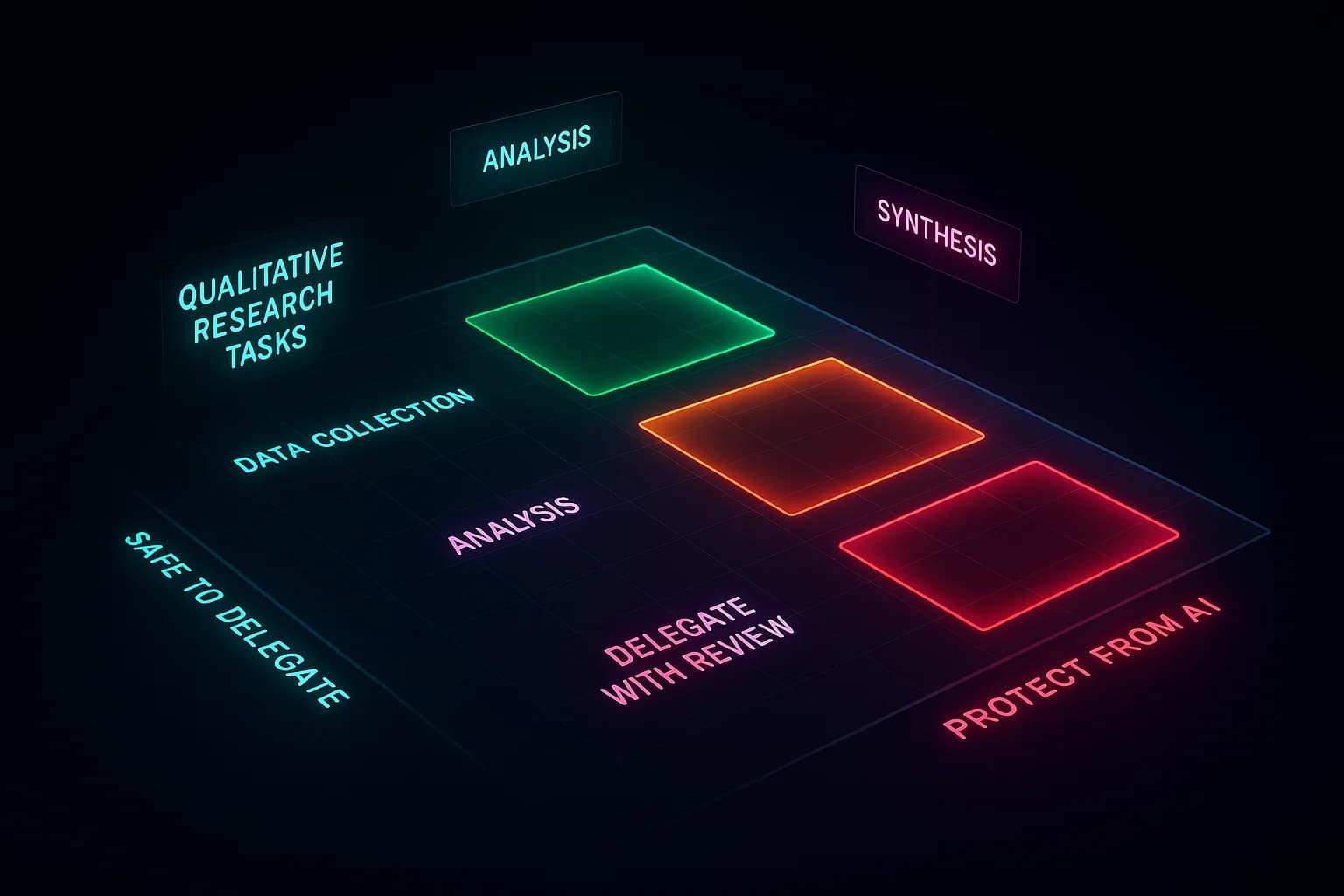
This story is not an argument against AI in qualitative research. It is an argument for knowing exactly where AI helps and where it harms. The tool did not fail — it was misapplied. It was given an analytical task (thematic interpretation) that requires human judgment, when it should have been given preparatory tasks (transcription cleaning, initial code suggestion, quote extraction) where its strengths align with the work.
What AI Does Well in Qualitative Research
To build a useful framework, we need to distinguish between the mechanical and the interpretive layers of qualitative analysis. The mechanical layer includes tasks that are labor-intensive, pattern-based, and do not require deep contextual understanding. The interpretive layer includes tasks that require empathy, cultural awareness, domain knowledge, and the ability to recognize significance in unexpected places.
AI excels at the mechanical layer. Specifically, it handles five categories of qualitative work faster and often more consistently than human researchers.
Transcription and Cleaning
AI transcription has reached near-human accuracy for most languages and accents. Beyond raw transcription, AI tools can clean transcripts by removing filler words, normalizing timestamps, and identifying speaker turns. This was always the most tedious part of qualitative research and the easiest to delegate. The time savings here alone — eliminating 6-8 hours of transcription per hour of interview — justify AI adoption.
Initial Code Generation
Given a transcript and a research question, AI can generate a preliminary codebook — a set of codes with definitions and example quotes. This is not the same as coding the transcript (which requires judgment). It is generating candidate codes that a human researcher reviews, refines, and applies. The AI's code suggestions serve as a starting point that accelerates the codebook development process by 40-60 percent.
Quote Extraction and Organization
Once a codebook is established, AI can scan transcripts and extract quotes that match each code. It can organize quotes by theme, by participant, by sentiment, or by any other dimension the researcher specifies. This is pattern matching at scale — exactly what AI does well. The researcher still decides which quotes are most representative and which carry the most analytical weight, but the extraction and organization is handled.
Cross-Transcript Pattern Detection
When you have twenty transcripts, spotting patterns across all of them is cognitively demanding. AI can identify recurring phrases, sentiment shifts, conceptual clusters, and frequency patterns across the full dataset in seconds. This gives the researcher a bird's-eye view before they dive into close reading — a map of the territory before they explore it.
Summary Generation for Stakeholder Communication
AI can draft summaries, executive briefs, and presentation outlines from coded research data. These are communication artifacts, not analytical outputs. They are structured text that communicates findings to stakeholders who will not read the full analysis. AI-generated summaries save researchers hours of writing time, though they should always be reviewed for accuracy and emphasis before distribution.
Where AI Introduces Bias
The failures of AI in qualitative research are not random errors — they are systematic biases that reproduce consistently. Understanding these biases is essential for any team using AI-assisted analysis.
Articulation Bias
LLMs are language models. They are inherently better at processing fluent, well-structured text than halting, fragmented, or non-standard speech. In qualitative research, this creates a systematic bias toward articulate participants. A participant who expresses their frustration in a clear, quotable sentence will have their insight weighted more heavily by the AI than a participant who struggles to articulate the same frustration in broken phrases. The less articulate participant may actually be experiencing the problem more severely — their inability to articulate it cleanly is itself data. AI misses this.
Majority Pattern Amplification
AI pattern detection optimizes for frequency. If fifteen of twenty participants mention a problem, the AI highlights it as a major theme. If two of twenty mention a different problem, it may categorize it as minor or omit it entirely. But in qualitative research, minority observations are often the most valuable. The two participants who noticed something nobody else did may be pointing at a problem that has not yet reached the majority but will. AI systematically under-weights minority signals.
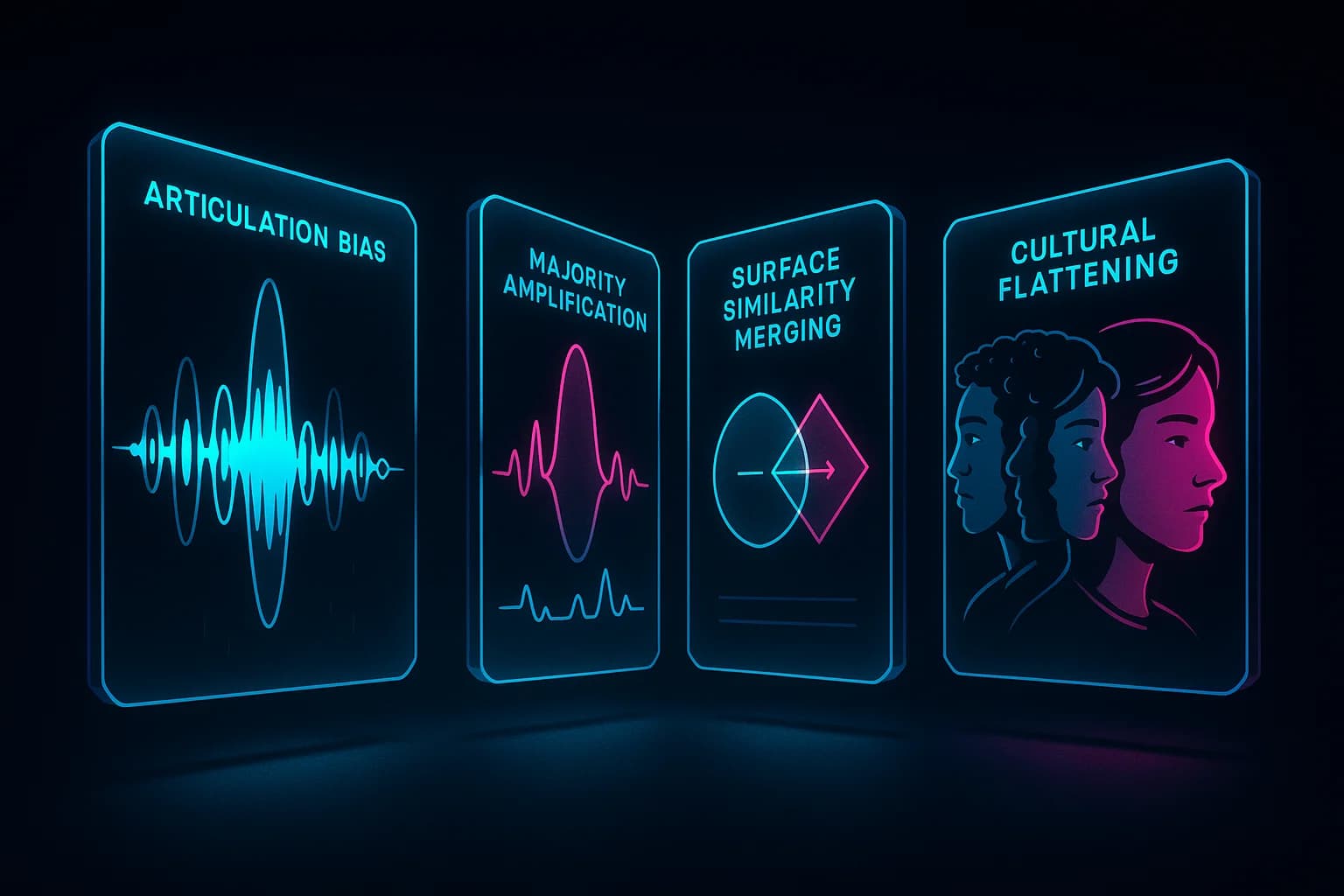
Surface Similarity Merging
AI groups concepts by linguistic similarity. Two themes that use similar vocabulary get merged, even if they represent genuinely different phenomena. The onboarding study example — where confusion about pricing and confusion about feature names were merged into 'unclear terminology' — illustrates this perfectly. A human researcher distinguishes these because they understand the different business implications. The AI groups them because the surface language overlaps.
Cultural and Contextual Flattening
Participants from different cultural backgrounds express the same concept differently. A direct American participant says 'I hated the checkout process.' A more indirect Japanese participant says 'The checkout process could perhaps be improved in some areas.' Both are expressing significant dissatisfaction, but the AI may code the first as strongly negative and the second as mildly negative because it reads the surface language literally. Cultural communication norms — indirectness, politeness conventions, understatement — are flattened into literal sentiment scores.
AI's biases in qualitative research are not random — they are systematic. Articulation bias, majority amplification, surface merging, and cultural flattening reproduce consistently. You cannot fix what you do not name.
A Validation Protocol for AI-Assisted Analysis
The solution is not to avoid AI — it is to validate its outputs with the same rigor you would apply to a junior researcher's first analysis. Here is a five-step validation protocol.
- Human-code a 20% sample: Before reviewing the AI's analysis, independently code 20% of the transcripts yourself. This gives you a baseline to compare against the AI's codes and reveals systematic differences in judgment
- Check for minority signal suppression: Explicitly review observations from the 2-3 least-represented participants. Ask whether the AI gave their observations appropriate weight or buried them as outliers
- Audit theme boundaries: For each theme the AI identified, ask whether it represents a single coherent concept or whether surface-similar but conceptually distinct issues have been merged. Split themes that contain genuinely different phenomena
- Cross-reference articulation with importance: Compare the quotes the AI selected as most representative with the full context. Ask whether less articulate participants expressed the same point in a way the AI overlooked
- Test the findings with a naive reader: Present the AI-generated findings to someone unfamiliar with the raw data and ask them what actions they would take. If their proposed actions differ from what the raw data supports, the AI's framing is subtly misleading
The Right Workflow: AI as Research Assistant, Not Research Lead
The optimal workflow positions AI as a research assistant that handles mechanical tasks under the researcher's direction, not as a research lead that produces findings for human review. The distinction matters because it determines who holds interpretive authority.
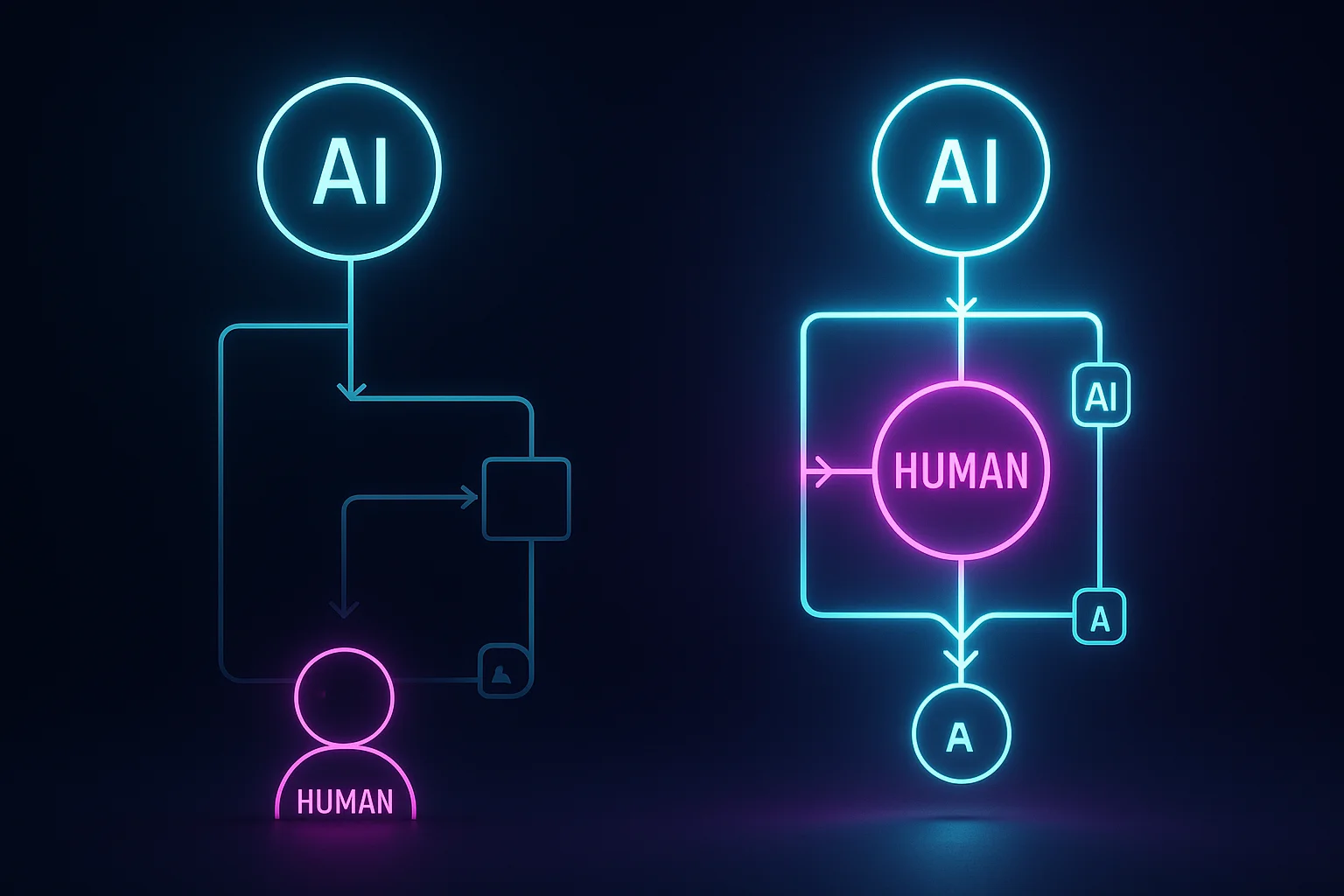
In the AI-as-assistant workflow, the researcher defines the research questions, designs the study, and conducts the interviews. The AI transcribes and cleans the data. The researcher reads a sample of transcripts to build initial impressions. The AI generates candidate codes based on the researcher's initial framework. The researcher refines the codebook. The AI applies codes across all transcripts and extracts supporting quotes. The researcher reviews the coding, corrects systematic errors, and performs thematic analysis. The AI drafts summaries and stakeholder communications. The researcher reviews and edits for accuracy.
At every stage, the human holds interpretive authority. The AI does the heavy lifting of pattern detection and text processing. The researcher does the thinking. This workflow captures 70-80 percent of the time savings of full AI analysis while preserving the interpretive rigor that makes qualitative research valuable. It is not the fastest approach. But it is the one that produces findings you can trust.
Prompt Engineering for Qualitative Research
The quality of AI-assisted analysis depends heavily on how you prompt the AI. Generic prompts ('analyze these transcripts and find themes') produce generic outputs. Research-specific prompts that encode methodological rigor produce dramatically better results.
- Specify the analytical framework: 'Using an inductive thematic analysis approach, identify themes that emerge from the data rather than mapping to predetermined categories'
- Require evidence: 'For each theme, provide at least 3 supporting quotes from different participants, including the participant ID and context'
- Demand minority attention: 'Flag any observation that appears in fewer than 3 transcripts but represents a potentially significant finding. Do not dismiss low-frequency observations'
- Set cultural sensitivity: 'Account for indirect communication styles. A statement like "it could be better" from a participant may indicate strong dissatisfaction expressed through understatement'
- Request counter-evidence: 'For each theme, also identify quotes that contradict or complicate it. Do not present themes as unanimous when they are not'
Key Takeaways
- AI excels at the mechanical layer of qualitative analysis: transcription, code suggestion, quote extraction, pattern detection, and summary drafting — collectively about 80% of the time investment
- AI introduces four systematic biases: articulation bias, majority pattern amplification, surface similarity merging, and cultural flattening — each must be actively counteracted
- Position AI as a research assistant (human directs, AI executes) not a research lead (AI analyzes, human reviews) to preserve interpretive authority
- Validate AI analysis with a five-step protocol: human-code a 20% sample, check for minority signal suppression, audit theme boundaries, cross-reference articulation with importance, and test findings with a naive reader
- Research-specific prompts that encode methodological rigor (require evidence, demand minority attention, request counter-evidence) produce dramatically better AI analysis than generic prompts
- The goal is not to do less research — it is to spend less time on mechanical analysis so you can invest more time in the interpretive work that makes qualitative research irreplaceable
AI will not replace qualitative researchers. It will replace qualitative researchers who do not learn to use AI effectively — and it will dramatically amplify the impact of those who do. The researchers who thrive will be the ones who understand, with precision, which aspects of their craft are mechanical and which are irreducibly human. Transcription is mechanical. Theme identification has both mechanical and human components. Insight — the moment when a pattern in the data reveals something nobody expected — is irreducibly human. AI makes the mechanical fast so the human can go deep. That is the promise. But only if you use it that way.
Qualitative ResearchAI AnalysisResearch MethodsThematic AnalysisResearch OpsAI Bias
KEEP READING
Related Articles
AI Research Methods·22 min read
Synthetic Users: What the Evidence Actually Shows About AI-Generated Research Participants
Vendors promise 90% cost reduction and 30-minute turnaround. The research tells a different story. Synthetic participants are too consistent, too agreeable, and systematically blind to the messy contradictions that make real user insights valuable.
AI UX Patterns·22 min read
Designing for Uncertainty: UX Patterns When AI Outputs Are Probabilistic
Traditional interfaces promise deterministic results. AI interfaces cannot. The gap between what users expect and what probabilistic systems deliver is where trust lives or dies — and most teams are designing for the wrong side of it.